
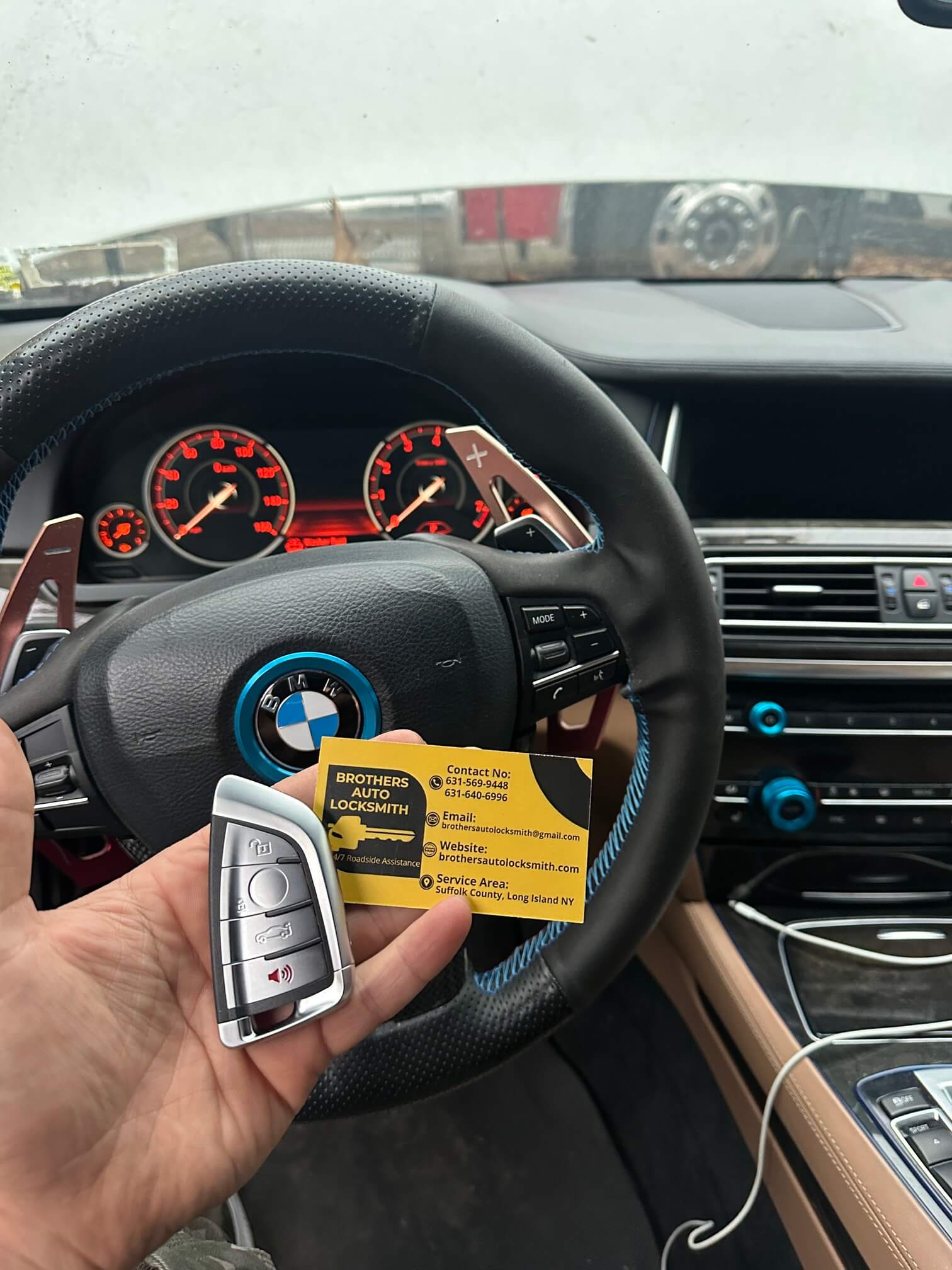
Locked out of your car in Suffolk County or Long Island? Here’s what actually helps, what makes it worse, and when to call a licensed mobile locksmith instead of trying it yourself.
A car lockout rarely happens at a convenient time. It’s usually mid-errand, mid-commute, or mid-shift keys visible on the seat, doors sealed, and no obvious way back in. It’s one of the most common calls a mobile locksmith receives, and in most cases, it’s also one of the fastest to resolve, provided you handle the first few minutes correctly.
What you do before help arrives matters. A large share of the lockout damage we see didn’t come from the lockout itself, it came from an attempted fix beforehand.
Start With the Basics
Before assuming the worst, run through a quick check:
- Check every door and the trunk: On some vehicles, a passenger door or trunk release can work independently of the driver’s side.
- Confirm whether a spare is nearby: with a family member, in a bag, or at home. If someone can bring it to you quickly, that’s the simplest resolution.
- Note whether the engine is still running: This changes both the urgency and the method a technician will use to get you back in safely.
If none of that resolves it, you’re dealing with a genuine lockout, and this is where the wrong next step tends to cause more damage than the lockout itself.
What to Avoid, Regardless of What You’ve Seen Online
Search “how to unlock a car door” and you’ll find plenty of videos showing a coat hanger, a shim, or a tennis ball working smoothly. What those videos rarely show is what happens on the vehicles where it doesn’t go smoothly.
Avoid coat hangers or wire tools: On newer vehicles, wiring and sensors are routed through the door panel in places a rigid wire can’t distinguish from the lock mechanism. Locksmiths are regularly called to fix a lockout and a damaged sensor as a result of this method.
Avoid prying the door frame with a screwdriver or pry bar: This is a leading cause of scratched paint and bent weatherstripping. Once the seal is compromised, the lockout is no longer the only issue.
Skip the tennis ball trick: It has no real effect on modern vehicles and was never a dependable method even on older ones.
Reserve breaking a window for genuine emergencies: such as a child or pet locked inside on a warm day. Even then, calling for help first is worth the attempt; a trained technician can often resolve the lockout without breaking anything.
The underlying issue is straightforward: modern door mechanisms, including flush-mount handles and capacitive sensors found on newer models, are not designed to be manipulated open with household tools. A method that worked on an older vehicle can genuinely damage a newer one.
What Helps While You’re Waiting
Once a locksmith has been called:
- Stay near the vehicle if it’s safe. Technicians typically confirm your exact location and vehicle description, and having eyes on the car helps avoid delays.
- Have identification or registration on hand. A legitimate locksmith should verify ownership before proceeding, particularly for vehicle lockouts.
- If you’re in a dark or isolated area, move to a well-lit spot nearby or stay on the phone with someone until the technician arrives.
- Let the locksmith know if you need to step away. Dispatch and timing are based on your reported location, so unexpected changes can delay the visit.
What Actually Determines Response Time
Once a technician arrives, most standard lockouts- sedans, SUVs, and typical vehicle locks – are resolved within minutes. The larger factor is travel time to your location, which depends on where you are relative to the nearest available technician.
For addresses in Coram, Centereach, Farmingville, and other close-in Suffolk County towns, response times tend to run shorter simply due to proximity. Locations further out – toward Riverhead, Central Islip, or Islandia – may take somewhat longer, though dispatching the nearest available technician (rather than one fixed location) keeps that gap as small as possible.
Why a Mobile Locksmith Is the More Direct Option
Some drivers default to calling a tow company for a lockout, assuming it’s the only option. It typically isn’t, and it’s rarely the more efficient one. Towing relocates the vehicle – it doesn’t open the door. A mobile locksmith comes directly to your location, whether that’s a driveway, a workplace lot, or the shoulder near a highway exit, and resolves the actual issue on-site.
There’s a secondary benefit as well: an experienced technician can usually tell within moments whether it’s a straightforward lockout or an early sign of something else, like a failing lock cylinder, and flag it before it becomes a bigger repair.
The Preventive Fix: A Spare Key
Most people don’t think about a spare key until they’re standing outside their car without one. Cutting a spare from an existing key is a quick, low-cost job, and it’s the most reliable way to avoid repeating this exact situation.
Licensed, Mobile, and Rated 5.0 Across Suffolk County
Brothers Auto Locksmith LLC is a licensed mobile locksmith operating entirely on a come-to-you model – no physical shop, no towing your vehicle anywhere, just a fully equipped technician dispatched to your location. The team works with professional-grade equipment, including Autel, Xhorse, and VVDI systems, covering most major makes and models from Toyota and Honda to BMW, Mercedes, Audi, and other European and domestic brands.
The business currently holds a 5.0-star rating across 150+ Google reviews, reflecting consistent, verified customer experiences rather than a marketing claim.
Service coverage spans Suffolk County and the surrounding Long Island towns, including Coram, Centereach, Farmingville, Terryville, Port Jefferson Station, Lake Grove, Medford, Patchogue, Port Jefferson, East Setauket, Hauppauge, Smithtown, and Riverhead. The team is available seven days a week, 7/24hr , with pricing based on the actual job rather than the situation.
Locked out right now? Skip the coat hanger and call a licensed technician directly. Brothers Auto Locksmith LLC: +1 631-569-9448